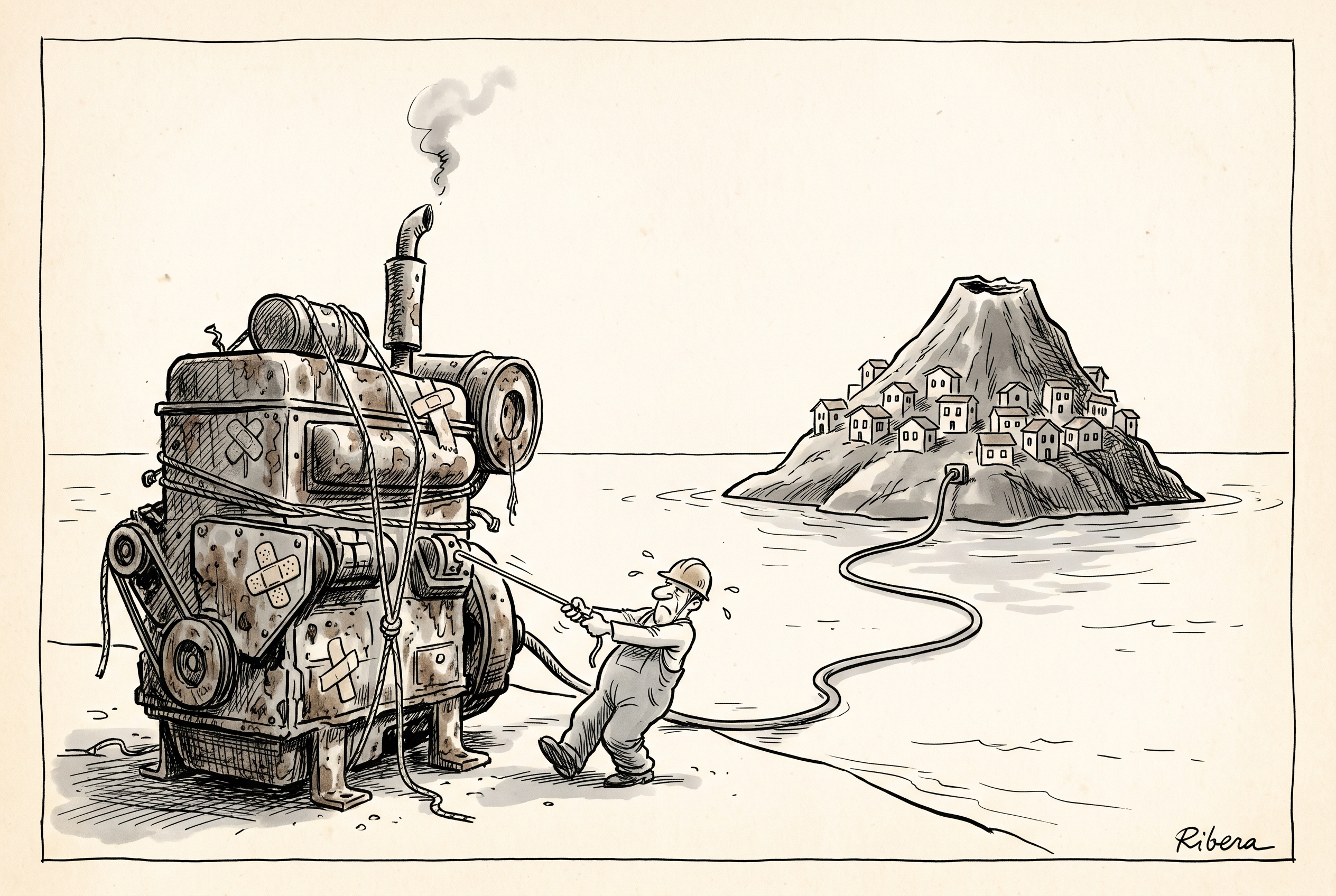
On Monday, at 06:38, the whole of La Palma went dark. Red Eléctrica counted 50,508 supply points without power and a cause that, for now, comes down to one sentence: every thermal generating unit supplying the island disconnected. Two and a half hours earlier, a storm had knocked out the 66 kV line between Los Guinchos and the Valle de Aridane, leaving 17,624 customers in the dark for an hour and a half. Power was not fully restored until 10:26, almost four hours after the blackout, because some engines at the Los Guinchos power station would not start on the first attempt and others had to be tried, according to Red Eléctrica itself.
It is wise to be careful about what is not yet known. The official report leaves the origin "to be determined" and points to the storm, and nobody has yet shown that the island-wide blackout was caused by an old machine rather than a fault in the grid. But there are two things that do not depend on that investigation. The first: an entire island depends on a single power station for its electricity. The second: when that station goes down, switching it back on is a matter of hours and of luck.
Nor is it a surprise. In June 2025 La Palma suffered another total blackout lasting more than three hours, and the one before that, during the Tajogaite eruption in 2021, lasted twelve. That summer Vozpópuli described the power station as a veteran of more than thirty years, with thirteen diesel units and some 80 megawatts installed that deliver considerably less, and renewables that barely topped 10 % at peak hours. The Gobierno de Canarias, the Canary Islands government, then presented a plan for the island that called for storage, more reserve capacity and strict compliance with the N-1 security criterion, the one requiring the system to withstand the loss of a single component. A year and a half later, the component was lost and the system did not hold.
What has followed the blackout looks far too much like the usual. The Canary Islands executive blames "obsolete equipment", with engines it says are more than fifty years old, and a Ministry that has kept it waiting thirteen years to replace them. Its regional minister for Ecological Transition, Mariano Hernández Zapata, maintains that the blackout "is the responsibility of Endesa and Red Eléctrica". And the same regional government blames the Cabildo, the island council, for blocking the Breñas substation and a new line towards the Valle, over an agreement that has not been signed. Everyone points at someone else. Meanwhile, the island is still hanging from the same cable.
The paperwork, by contrast, moves at another speed. The state tender to renew generation on the islands was called in 2024, under a law from 2013; for La Palma only Endesa bid. According to the Canary Islands government, the first tender, decided in February, awarded more than a thousand megawatts across the archipelago, but in La Palma it is limited to seven existing units at Los Guinchos, 44.23 megawatts that add no new capacity. Red Eléctrica calculates that the island needs another 52 megawatts of firm power, scheduled for 2031 in a second tender. The new engines, the regional government itself admits, "still have to be manufactured".
The piece that could change things before that date is batteries. In June, a royal decree-law finally allowed storage to be used as an emergency resource in the non-peninsular territories, at the Canary Islands' request. For La Palma there is talk of some 16 megawatts with two hours of autonomy, paid 25 % by the State and 75 % by the regional government. It is almost exactly what was needed on Monday: stored energy capable of holding up the grid while the engines start. But at the end of June the call to allocate it had been in draft for months, with no date for award or installation.
The best counterargument deserves a hearing. Isolated grids are difficult, a storm can bring down any line, and renewing a power station properly takes years of engineering, manufacturing and permitting. That is true. Which is precisely why progress can no longer be measured in studies, pending agreements and tenders that award what was already there. Neighbouring El Hierro shows that a small island can combine wind and storage: Gorona del Viento covered all of its demand with renewables for 1,049 hours in 2025. It is not a solution to copy as is, but it is proof that storage is not science fiction in the Canary Islands.
What La Palma is asking for is not one more culprit, but three dates. When the emergency batteries will be connected, when the agreement unblocking the Breñas substation will be signed and when the new firm power will arrive, without waiting until 2031 if it can be brought forward. With a public official responsible for each, reporting on them every quarter. The Canary Islands declared an energy emergency in October 2023. Three years later, an emergency managed with drafts has stopped being one and become a habit.
This time the lights came back before lunch. Next time the start-up may not be so lucky, and there is no technical reason to stake everything, once again, on the engine catching on the third pull.
This story stands on its own facts. The Post Apocalyptic does not link it to other incidents unless the sources demonstrate a connection.
Sources
- Red Eléctrica confirma que la desconexión de todos los grupos térmicos provocó el cero energético de La Palma
- Dos apagones dejan sin luz La Palma a causa de «unos equipos obsoletos» cuya renovación lleva 13 años esperando al Ministerio
- Cero energético en La Palma: la isla sufre un apagón general y Emergencias declara la situación de alerta
- Los apagones de La Palma y El Hierro exponen las carencias crónicas del sistema eléctrico canario
- Tres apagones, un sistema obsoleto y un cruce de acusaciones: La Palma, en el filo energético
- El Gobierno autoriza el uso de baterías como recurso de emergencia energética en La Palma
- Endesa, única empresa en presentarse al concurso de generación eléctrica para la isla de La Palma
Public history
- — Published (editorial approval)