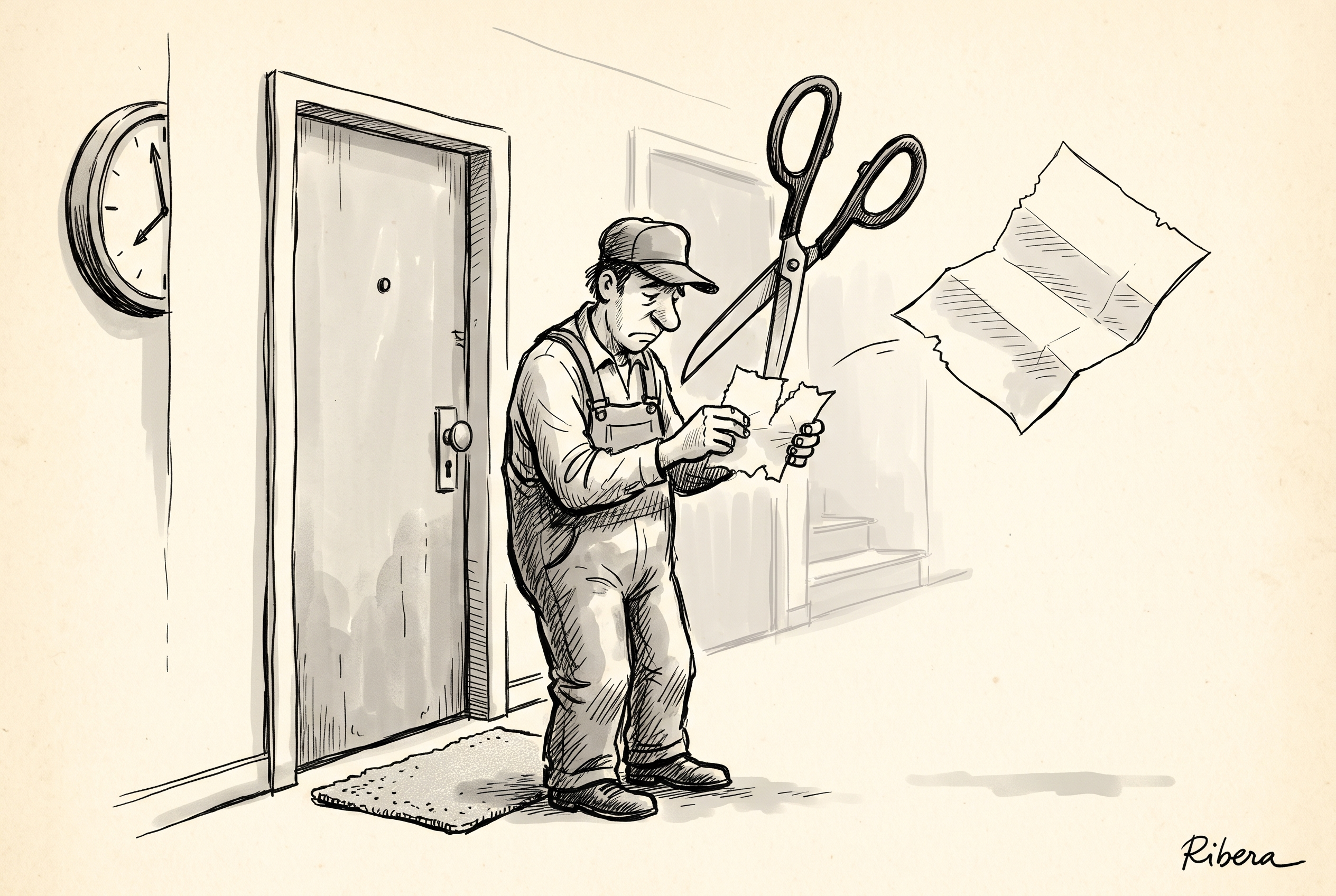
There is a figure worth reading slowly: 2.5 million people in Spain have a job and, even so, live below the poverty line. It appears in an EFE report published this Monday, which brings together data from the European Anti-Poverty Network (EAPN-ES), Oxfam Intermón and Eurostat. According to EAPN, poverty affects 11.6% of people in work; if housing costs are taken into account, Oxfam raises it to 15.5%, some 770,000 more people. Eurostat ranks Spain as the country in the Union with the third-highest share of working poor: 11.2% in 2024, compared with an average of 8.2%.
The easy conclusion would be that Spain pays a pittance per hour. The numbers say otherwise. The 2026 minimum wage comes to 17,094 euros gross a year for full-time work, and the INE puts the poverty line for a person living alone at 12,220 euros net. Someone who lives alone and earns the full-time minimum is above the line. That same wage part-time comes to about 8,550 euros gross: below the line before a single tax has even been paid. The problem is not the price of the hour. It is how many hours people are allowed to work.
Luis Pérez of Randstad sums it up in the same report: “The fundamental failure lies in the intensity of employment.” Few hours a year, however well each one is paid. The experts consulted by EFE point to involuntary part-time work as the main cause, that of someone who signs up for twenty hours because no one offers them forty. According to the EPA labour force survey, some 3 million people work part-time, 12.9% of the 22.8 million people in employment, and more than 70% of them are women, according to CCOO's calculations.
That is where the gap lies. “In Spain there is no rule that prohibits” a company from having most of its workforce on part-time contracts, notes Cristina Torre of CCOO. A part-time contract does not need to be justified, and supplementary hours, those added as needed, make it possible to stretch a short working week almost to full time without the worker gaining the stability of a full-time contract. For the company it is flexibility. For whoever signs it, it is a payslip whose amount they do not know until the end of the month and a life they cannot plan.
No sweeping laws are needed to start closing it. First, part-time work should require a justification when it is imposed by the company, as CCOO proposes, and supplementary hours that are repeated month after month should become part of the contract. Second, the Labour Inspectorate should prioritize pursuing part-time contracts that conceal worse-paid full-time hours, which is not flexibility but fraud. Third, official statistics should also measure in-work poverty after housing costs: a poverty line that ignores rent portrays a country that no longer exists.
The best argument against deserves an answer. For many people, part-time work is a choice: students, those who care for someone, those who want to balance work and family. And making it more expensive, it will be said, would destroy jobs in hospitality and retail, sectors with narrow margins and demand that rises and falls with the season. It is a serious argument, and that is why what I propose prohibits nothing. Part-time work that is chosen should remain easy; what should come at a cost is part-time work that is imposed. The same warning was heard before every rise in the minimum wage, which has grown by 66% since 2018 according to CCOO, and today the country has 22.8 million people in employment.
Nor can everything be fixed in the contract. According to Oxfam Intermón, 21.7% of the self-employed live below the poverty line, more than double the rate for employees (10.3%): there, there are no working hours to regulate, just income that falls short. And when work fails, the public safety net does little: according to EAPN-ES's annual report, social transfers reduce poverty in Spain by 23.2%, compared with 38.5% in France and 51.5% in Ireland. A country that works a lot and protects little ends up leaving to luck what it should entrust to the system.
The map matters too. The Valencian Community (17.5%) and Andalusia (17.4%) have the highest rates of in-work poverty; Navarre, the lowest (5.3%). Pérez attributes this mainly to the structure of the economy, and it makes sense: where seasonal, low-hour jobs abound, the minimum wage protects less, because it is earned for less time.
Over the coming weeks there will be many promises about wages. It is good that they are made. But anyone who truly wants to lift out of poverty two and a half million people who already work will have to look less at the figure on the payslip and more at the box that almost no one reads: the one for hours.
This story stands on its own facts. The Post Apocalyptic does not link it to other incidents unless the sources demonstrate a connection.
Sources
- Trabajar y seguir siendo pobre, la realidad de 2,5 millones de ocupados en España
- Trabajar y seguir siendo pobre, la realidad de 2,5 millones de ocupados
- Pobreza laboral en España: 2,5 millones de trabajadores viven bajo el umbral de pobreza pese a tener empleo
- Temas del día de EFE España del lunes 2 de noviembre de 2026
Public history
- — Published (editorial approval)