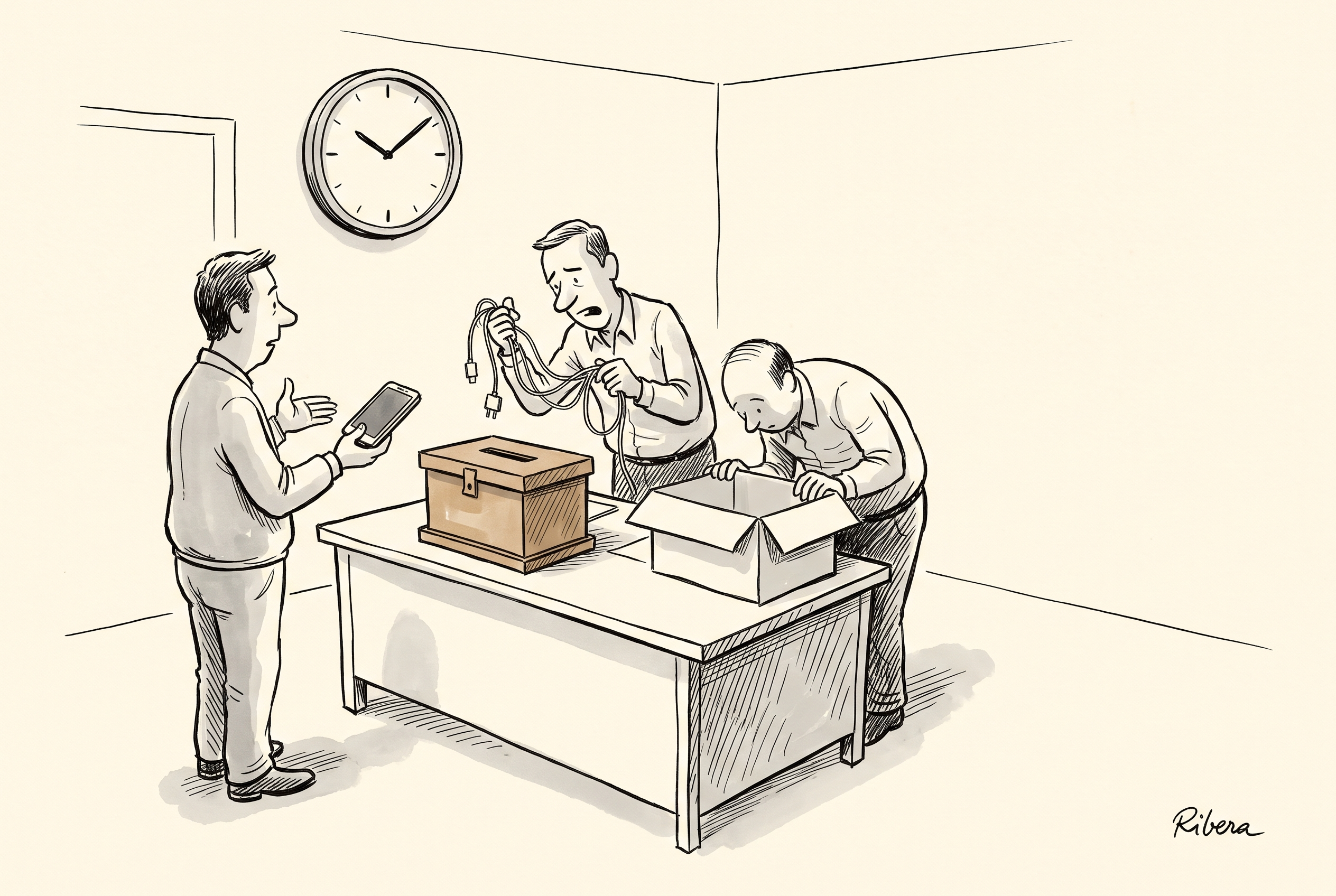

On 29 November we will be able to identify ourselves to the polling station officials with our phones. On Thursday the Central Electoral Board lifted the suspension it had imposed in March on the MiDNI app, and on Friday the Interior Ministry announced that the digital ID card will be valid at the general election. That is good news, and not for the first time: the Board had already accepted it in September 2025, withdrew it on 26 March and has now restored it. A tool like this having to earn trust twice is not a failure. It is what should happen to anything that comes near a ballot box.
It is worth being clear about what changes and what does not. Nobody will vote by phone. Voting is still on paper, in an envelope and in person; the only thing that changes is how each of us proves who we are. According to the Interior Ministry, the voter opens MiDNI in front of the polling station officials and generates, on the spot, a temporary QR code issued by the National Police. The officials read it with a device with a camera and a browser that has the official verifier built in. The app has been assessed and certified by the National Cryptologic Centre, and anyone with a digital ID card has been able to use it as identification since 2 April this year.
The history of the suspension explains why the QR code matters. In its first ruling, the Board considered it sufficient for the holder to open the app in front of the officials, because it was an official document with a photograph. The PP and the regional government of Andalusia asked for a review: they argued that an image on a screen cannot be checked and that it opened the door to impersonation. On 26 March the Board suspended MiDNI and MiDGT "until it is guaranteed" that verification is sufficiently secure. The condition requested was that every polling station should be able to check the code in real time. The Interior Ministry now says it will meet it, and the Board has accepted that.
The objection was reasonable, and that is why the solution is too. A screen can be faked; a temporary code generated by the police on the spot and checked by the officials with their own device, far less so. The system that debuts on 29 November is better than the one approved in 2025, precisely because someone was suspicious. Nor does it start from scratch: the digital ID card was already used in the regional elections in Extremadura, Aragon and Castile and León, and the electoral boards consulted by Maldita recorded no incidents.
The best argument against it is not about security but about caution. A general election is no place to try anything new, someone will say: better to test it first in smaller elections. I am not persuaded. Its use will be voluntary, it will sit alongside the plastic ID card, the passport and the driving licence (even expired, never as a photocopy), and only a minority will use it: almost 2 million people have registered their details in MiDNI and more than 1.75 million have activated it. If something fails, the cost is a slightly longer queue, not a lost vote, as long as the voter also carries the physical document.
What worries me is something else: the logistics of the day itself. The Interior Ministry will hand out more than 60,000 devices through Correos, the postal service, on 29 November itself, at 28.06 euros for each delivery and collection, according to the ministerial order cited by Europa Press. In other words, the presiding officers and members, ordinary citizens chosen by lot, will receive the reader on polling day itself. The reports on the decision themselves warn that checking will be slower than with the physical document. And neither the Interior Ministry's statement nor the published reports explain what a polling station should do if the device does not arrive, has no signal or runs out of battery.
That gap must be closed before the campaign, not at nine in the morning on polling day. The handbook for polling stations, approved by the Council of Ministers on 27 October, already includes this form of identification; the Board's resolution will be passed to the provincial boards so that they can relay it to the polling stations. Let it arrive with a one-line instruction: if the verifier does not work, the voter must identify themselves with a physical document, and the incident is recorded in the minutes. And let the Interior Ministry tell citizens too, as clearly as it announces the novelty: anyone planning to use their phone should also bring their ID card in their wallet.
There is a lesson that goes beyond 29 November. Spain's digital administration is moving at a good pace, but it wins or loses trust in moments like this one, when an ordinary person, in an ordinary school, shows their phone to three neighbours sitting behind a table. If that moment goes well at thousands of polling stations, the digital ID card will have earned more credibility than any communication campaign could buy. If it goes badly at a few, and nobody knew what to do, the next suspension will be ready and waiting.
The Board was right to demand real verification, and the Interior Ministry was right to provide it. What remains is the least glamorous and most important part: that every polling station has, besides the reader, a plan for when it fails.
This story stands on its own facts. The Post Apocalyptic does not link it to other incidents unless the sources demonstrate a connection.
Sources
- El DNI digital será válido como medio de identificación en las Elecciones Generales del 29 de noviembre
- La JEC autoriza de nuevo el DNI digital tras garantizar Interior lectores QR en todas las mesas
- La Junta Electoral autoriza votar con el DNI digital el 29-N, pero mantiene vetado MiDGT
- ¿Se podrá votar con el DNI electrónico en las elecciones generales del 29 de noviembre en España?
- El uso del DNI digital para votar: preguntas y respuestas
- Oficial: podremos usar nuestro DNI digital para votar en las próximas elecciones
Public history
- — Published (editorial approval)