
On Monday, an average of 4,815,000 people watched David Broncano's interview with Santiago Abascal on La Revuelta, a 33.6 % audience share. It is the most-watched broadcast in the show's history, above the 4,387,000 viewers drawn by Pedro Sánchez on 22 October, and 8.67 million people watched at least one minute of it. Twenty days before the 29 November general election, the figure says something worth not losing amid the noise: a great many people want to watch candidates answer questions for more than an hour and a half.
Tuesday's conversation is about who won. For Abascal, speaking as he left, it was "a very serious debate" rather than an interview; on COPE he said he saw Broncano worried about his own circle, because "the left is very cruel to its own", and admitted he would have liked to explain some ideas better. elDiario.es's report argues that the Vox leader "got his message across" and that the host lacked the data to press him. The farewell, with Abascal wishing Broncano luck "because you are going to need it", is already circulating on its own. All of that is spectacle, and as spectacle it worked.
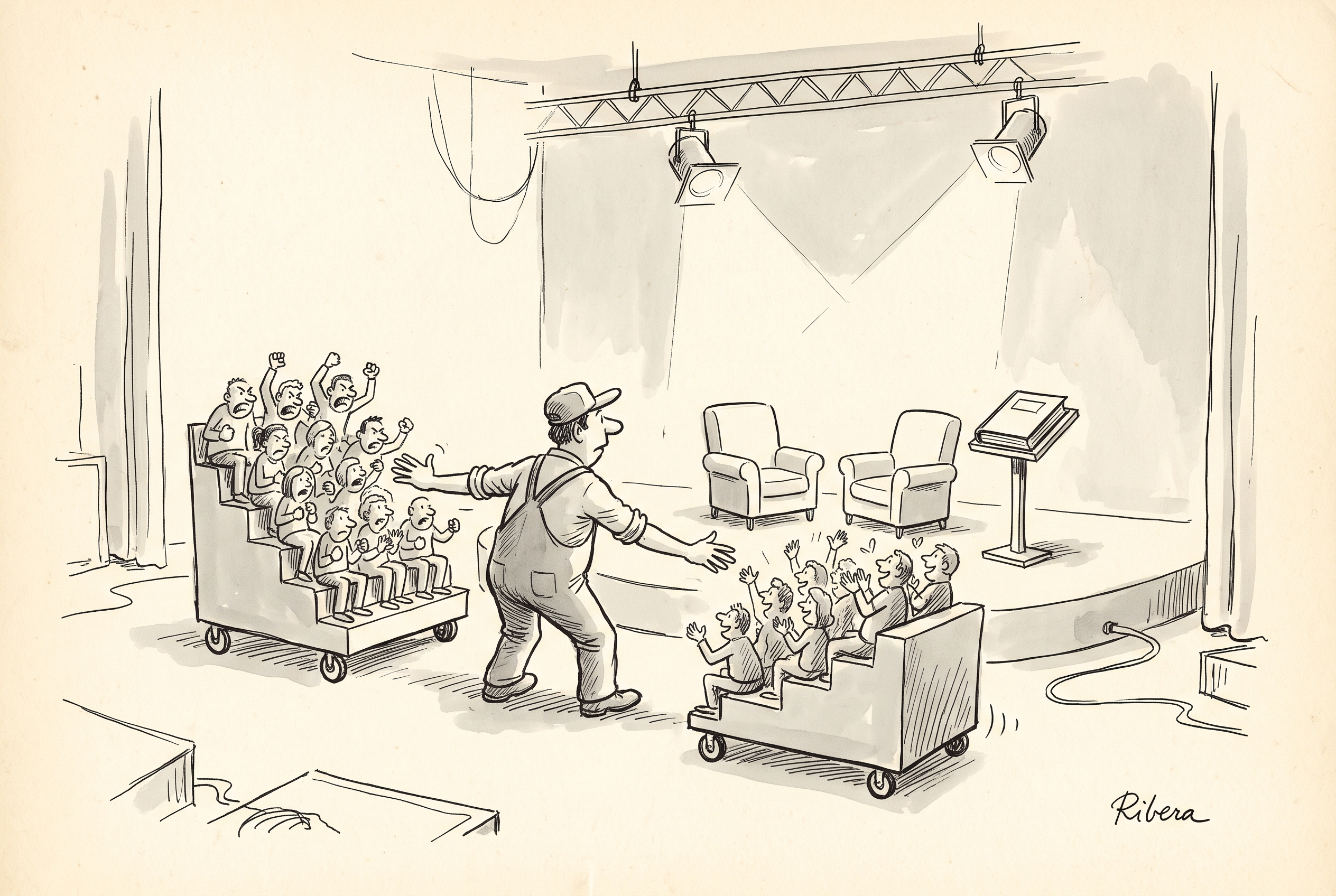
What matters to me happened before the cameras were switched on. When Broncano announced the visit, part of the studio audience booed it. On Friday, the production company cancelled the attendance of every spectator who had a confirmed seat. According to La Séptima, as reported by FormulaTV, Vox had refused to appear before what it considered a hostile audience, offered to bring its own attendees and later proposed a "demographic" audience. Neither the broadcaster nor the production company explained this at the time. On Monday, the show opened by clarifying that the audience had been chosen by an agency, and Abascal walked in to applause and shouts of "president".
Neither of the two audiences was neutral. The usual one, which booed the announcement, was not. The agency one, which cheered the guest, was not either. And that is the point: in a show where the audience laughs, applauds and boos live, the stands are part of what the viewer at home sees. If each candidate arrives under different conditions, public television stops offering everyone the same stage, even if it asks them all similar questions.
Broncano knew this. When he announced the interview he explained, according to Espinof, that it is the Central Electoral Board that requires all of them to be invited. But the equality a campaign demands does not end with the invitation: it includes the length, the format and who is in the room. And those conditions cannot be negotiated privately with each party and revealed on the day of broadcast.
The best counter-argument comes in two versions. The first says Abascal should not have been invited, because it gives him a platform. Broncano himself answered that before the interview: the message is already amplified, Vox is already in the debate. He is right, and I would add that this is the candidate of a party with parliamentary representation in a general election; on public television, a speech is answered with a question prepared with data, not with an empty chair. The second version says La Revuelta is a comedy show and needs no protocols. It would be, had it not gathered almost five million people three weeks before a vote, with the main candidates invited. At that scale, a comedy show is election information, on the broadcaster we all pay for.
The proposal is simple. RTVE should publish now, before the campaign starts, a one-page set of rules for election interviews on all its programmes: how long they last, how the audience is chosen (by lottery among those who apply, for example, or with no audience during the question blocks), what a programme does if a party sets conditions, and who answers for those decisions. The same for every candidate and known before the next one arrives. Alberto Núñez Feijóo, who has yet to confirm whether he will appear, would know what to expect, and so would viewers.
Monday's audience does not crown a winner; it shows there is demand for long interviews with candidates. Public television has the chance to offer them with clean rules. It should not waste it arguing, after every show, about who filled the stands.
This story stands on its own facts. The Post Apocalyptic does not link it to other incidents unless the sources demonstrate a connection.
Sources
- Audiencias TV lunes 9 de noviembre: 'La Revuelta' firma su entrevista más vista con Abascal
- Abascal arrasa en 'La revuelta' y supera en audiencia a Sánchez
- Abascal pidió elegir al público de 'La revuelta', que cancela a todos los asistentes
- La entrevista con Abascal le estalla en la cara a Broncano
- Abascal responde a Broncano tras su cara a cara en 'La Revuelta'
- Santiago Abascal confirma su visita a 'La Revuelta' y David Broncano promete estar más contenido
Public history
- — Published (editorial approval)