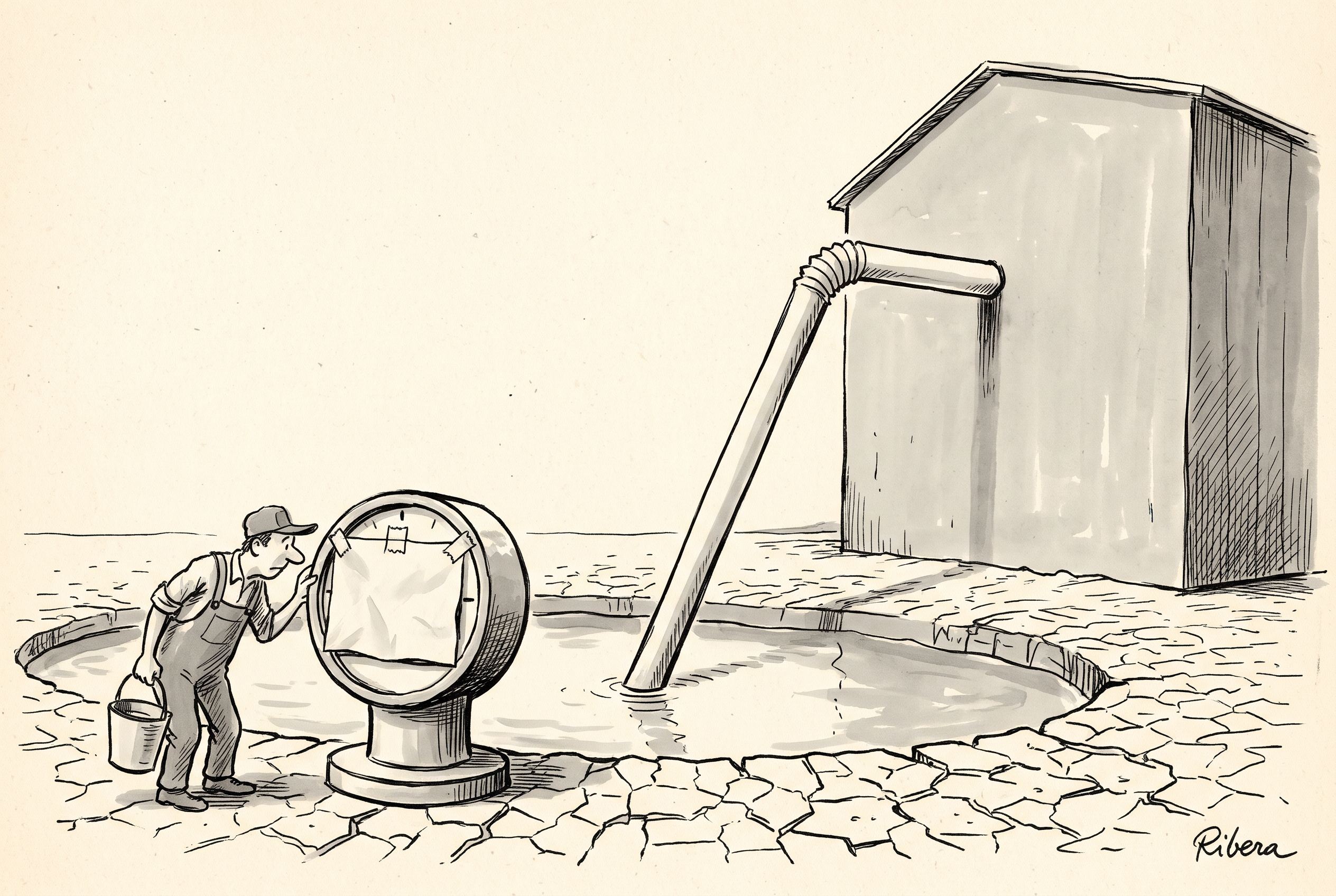

On Saturday some 5,000 people, according to the organisers (2,000, according to the National Police), marched through central Zaragoza to the seat of the Aragonese government to demand a moratorium on data centres. It was part of a European day of action with 75 events, around twenty of them in Spain. «There is not enough water for so much data», they chanted. It is a good line for a banner. As a diagnosis it has a problem: today nobody can check whether it is true or false, and that is the flaw that should be fixed before one more building is authorised.
It is worth starting with what the known figures say, because they do not always side with the street. At the end of October, the Aragonese Institute for Environmental Management authorised Amazon Web Services to increase the water allowance of its El Burgo de Ebro centre by 48 %, because water cooling goes from 555 to 900 hours a year. With all its expansions, the company's maximum in the area would be 0.92 cubic hectometres a year. The paper mills of the Ribera Baja use more than 20. Microsoft says its three closed-circuit campuses will use 27,717 cubic metres in the first year and 3,973 afterwards, what 83 people drink. The Azora and Blackstone projects, which are air-cooled, add up to about 10,800 cubic metres.
That is the best argument of those who defend the wave of investment: the water is little, the fear is great, and a single traditional industry on the river uses twenty times more without anyone taking to the streets. In September the Aragonese president went as far as saying, at a forum organised by Amazon itself, that the data industry contributes more water than it consumes. He may be right. The problem is that the only way to know is to trust the figures the company provides.
Because almost everything we know comes from the developers' own paperwork. In their objections to the El Burgo de Ebro expansion, environmental groups recalled that an investigation by El País estimated that the Huesca centre had used almost double what it was granted, and they asked for independent checks, because the rules do not oblige these companies to report what they use. Forecast consumption is revised upwards as soon as the climate tightens. And the Government of Aragón, according to a count by the Fundación Basilio Paraíso, has given its general-interest seal to nine projects with 82 buildings without publishing an official list of who is behind each one.
Without a public meter there is no debate, just two camps. One side says «plunder» and the other «a drop in the ocean», and neither has to prove anything. A region that lives off the water of the Ebro and the Gállego deserves better than choosing whom to believe.
The demand is simple to state and should not scare any serious investor: every centre with a remote-read abstraction meter, read by the river basin authority and not by the company, with its monthly consumption published openly; independent audits every year; and the authorisation tied to those readings, so that exceeding the granted flow has consequences.
And a second rule is needed, before the next drought and not after it: who gives way first when there is not enough for everyone. On 15 September the Camarera irrigation channel, in the Gállego basin, saw its allowance cut to 35 %, a restriction that affected some 4,500 hectares. Pedro Arrojo, the United Nations rapporteur on the right to water, summed it up at the march: in normal years there will be water for everything; the question is who will have priority when it runs short. If a data centre connected to the urban network goes ahead of irrigation, let it be said now and in writing, with the order of cuts published. And if it should not, that too.
I do not share the indefinite moratorium demanded at the head of the march. Stopping everything until it is regulated can end in never regulating, and the investment would move to Castilla y León or Extremadura with the same legal gaps. But the opposite will not do either: granting first and measuring later. The Ministry for the Ecological Transition is processing a royal decree that will set how much water and electricity each facility may use. The sensible thing is for Aragón not to approve any more general-interest seals until that limit exists and can be checked.
Water, moreover, may not be the most serious issue. Microsoft expects its campuses to use 10,550 gigawatt hours a year at full capacity, more than the whole region in 2024, and Red Eléctrica has already granted grid connection permits to 3,700 megawatts of data centres in Aragón, more than double the regional peak demand. That bill will also have to be counted. But water is what people understand and what frightens them, and that is why it is where the data should start.
The cloud is not a cloud: it is a two-hectare shed next to a village. If it uses little, let a meter we can all read prove it.
This story stands on its own facts. The Post Apocalyptic does not link it to other incidents unless the sources demonstrate a connection.
Sources
- El rechazo a los centros de datos colapsa Zaragoza: "No generan empleo, no pagan impuestos y se quedan los recursos"
- España lidera la primera movilización europea contra los centros de datos: “Las promesas de la IA son falsas”
- Autorizan a Amazon a gastar un 48% más de agua en su centro de datos de El Burgo de Ebro. Los agricultores no opinan igual
- Centros de datos en Aragón: nueve proyectos de interés general que sumarán más de 80 edificios
- Microsoft asegura que sus centros de datos en Aragón solo consumirán agua para el llenado inicial de los circuitos
- Azora y Blackstone: dos centros de datos absorberán casi el 70% de la electricidad que consume hoy Aragón
- Colectivos de Aragón se movilizan contra los macrocentros de datos por su impacto
Public history
- — Published (editorial approval)